
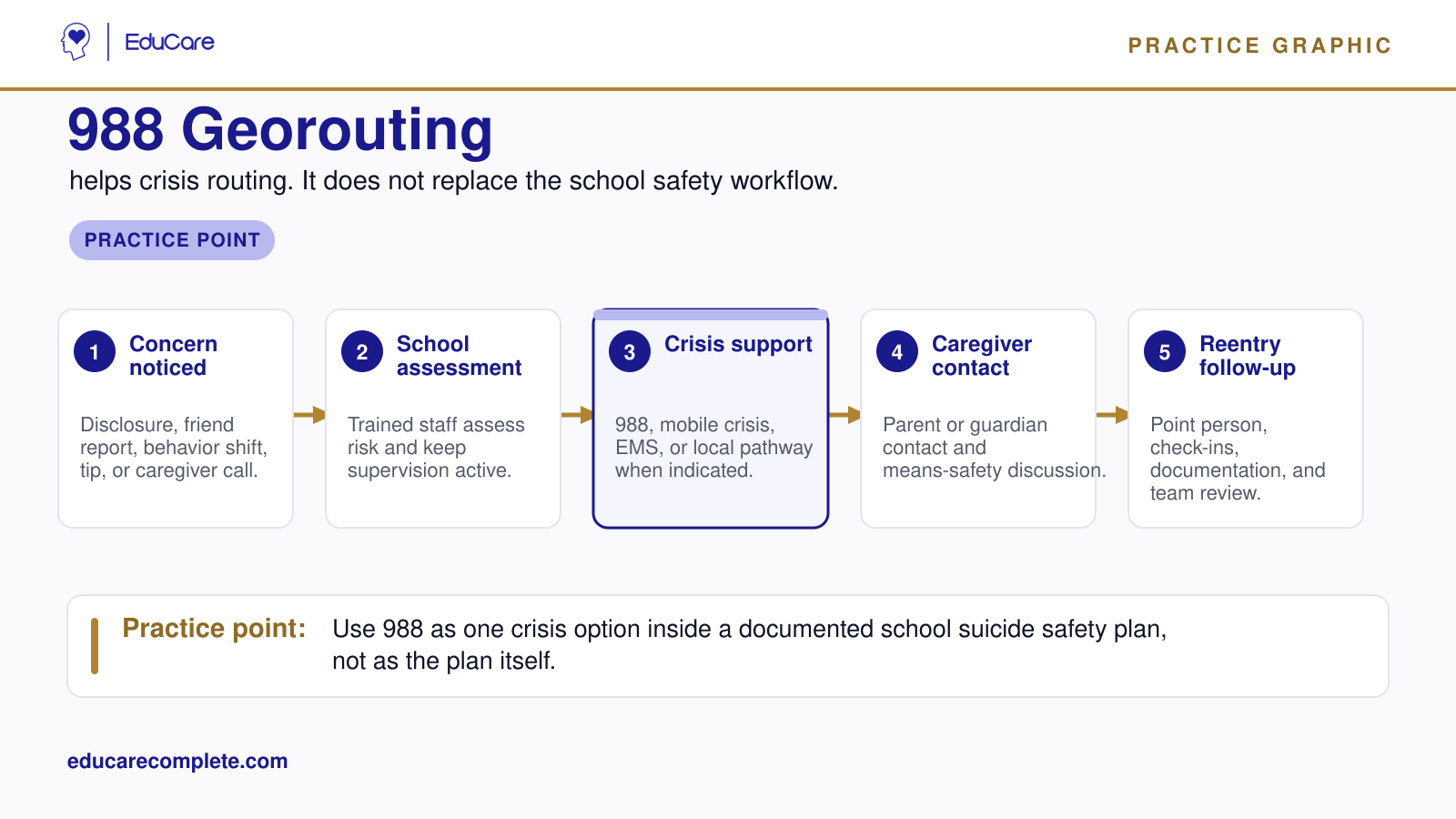
A school suicide safety plan cannot stop at "call or text 988." The federal move toward 988 georouting matters, and it should make crisis support more local over time. But for school-based clinicians, counselors, behavior analysts, administrators, and crisis teams, it does not replace the core work of building a local, documented, practiced response for students at risk of suicide.
That distinction matters because 988 is easy to over-simplify. It is visible, memorable, and important. It also sits outside the daily machinery of a school day. A student in crisis may be in a classroom, on a bus, in the health office, at home during a school threat assessment follow-up, or texting from a phone with limited context. The school still has to decide who assesses risk, who supervises the student, who contacts caregivers, when emergency services are used, how documentation is completed, and what reentry looks like.
School Suicide Safety Plan Work Starts Before the Call
When a student discloses suicidal ideation, the first useful question is rarely, "What number should we give them?" The first question is, "What is our role right now, in this setting, with this level of concern?"
That is where a school suicide safety plan earns its keep. A good plan is not a poster, a referral list, or a boilerplate form that lives in a shared drive. It is a live workflow. It tells adults what to do when the concern is vague, when caregivers are unreachable, when the student uses 988 by text, when the family wants to handle it privately, and when the student returns after an emergency evaluation.
I am not arguing against 988. I want school teams to know it, use it appropriately, and include it in student-facing and caregiver-facing resources. The problem is making 988 carry responsibilities it was not built to carry. A crisis line can support de-escalation, safety planning, connection to local crisis resources, and immediate crisis counseling. It cannot observe the student in the hallway after the call ends. It cannot document the school's decision making. It cannot ensure the substitute teacher knows the reentry plan. It cannot decide whether a particular district policy requires parent notification or administrative escalation.
Those are school responsibilities. They need to be clear before the crisis begins.
What 988 Georouting Actually Changes
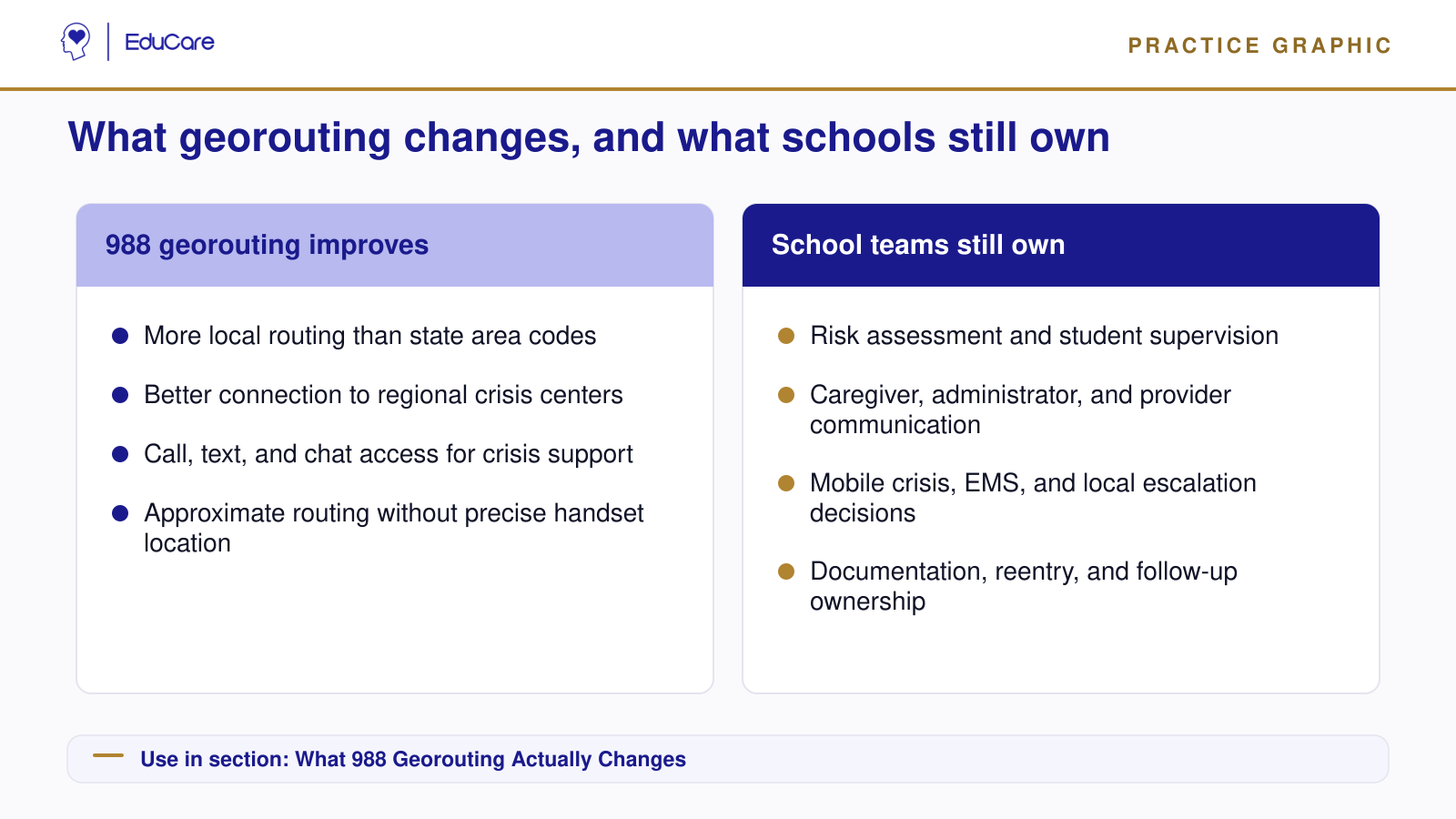
The federal georouting shift is still worth understanding. Historically, many 988 calls could be routed based on the caller's area code rather than the caller's actual general location. That matters in school practice because students and caregivers often keep phone numbers after moving. A student sitting in Arizona might have a California area code. A caregiver might have moved across the country but kept the same wireless number. Area-code routing can send a caller to a crisis center that is not closest to the person in crisis.
The Federal Communications Commission's 2024 voice rule moved wireless 988 calls toward routing based on the general area of the handset, while avoiding precise location disclosure. The 2025 text-to-988 rule applies a similar logic to text providers. The FCC described georouting for text as using aggregated cell-based location data to route texts more locally, without sending precise handset location or cell site location to the Lifeline.
In practical terms, georouting should reduce one common mismatch: a student or caregiver reaches 988 but gets routed according to a stale area code. That is good. Local crisis centers are more likely to know regional mobile crisis options, emergency department patterns, and local referral realities.
But georouting is not a location-tracking system for schools. It does not mean 988 knows exactly where the student is. It does not mean 988 replaces district policy. It does not remove the need for a school-based assessment, caregiver communication, means-safety discussion, supervision plan, reentry plan, or documentation.
The more accurate practitioner takeaway is simple: 988 is becoming better connected to local crisis infrastructure. School teams still need a local school workflow for suicide risk.
Where School Responsibility Still Starts
ASCA's position on suicide prevention, intervention, and postvention names a direct school counselor role in protecting student well-being, making sure policies and procedures exist, informing parents and appropriate school personnel when serious and foreseeable harm is present, and supporting reentry after crisis or hospitalization. NASP similarly emphasizes clear school policies, trained school-employed mental health professionals, crisis teams, and suicide prevention as part of a larger MTSS framework.
That gives us a practical frame. A school plan should not be written as if risk appears only during a counseling appointment. Risk may surface through a friend report, threat assessment, discipline incident, attendance pattern, social media concern, self-harm disclosure, anonymous tip, autism-related distress, bullying complaint, or caregiver call. The plan has to work across entry points.
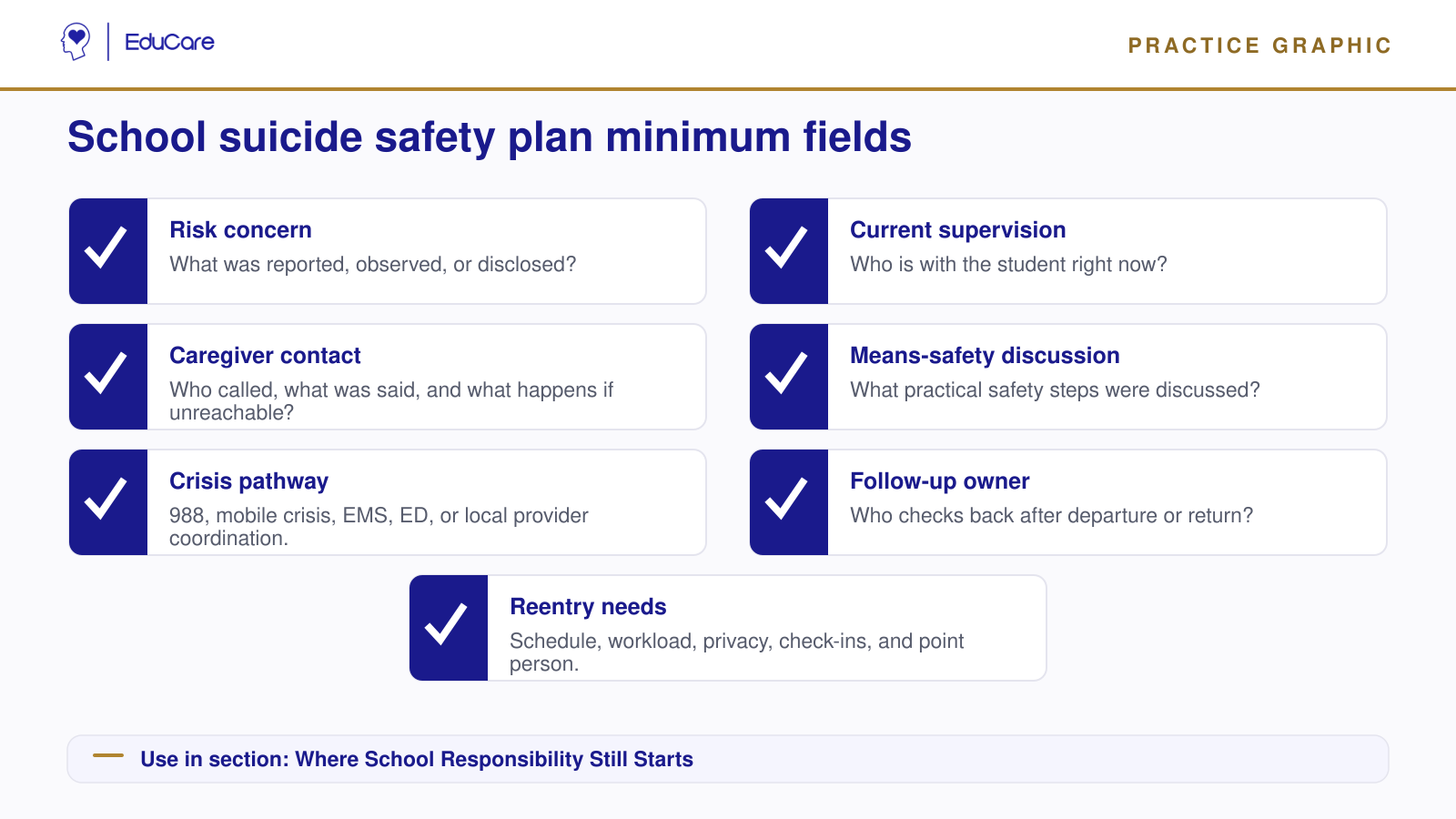
At minimum, the workflow should answer these questions:
Who is authorized and trained to conduct the initial suicide risk screening or assessment during the school day?
Who supervises the student while the concern is being assessed?
Who contacts the parent, guardian, administrator, and outside provider, and in what order?
What happens when caregivers cannot be reached?
When does the team use 988, mobile crisis, emergency medical services, or law enforcement?
What documentation is required, and where is it stored?
Who owns the follow-up after the student leaves campus or returns to school?
If those questions are not answered, 988 will become a patch for system ambiguity. That is not fair to the student, the family, the crisis counselor, or the school-based provider.
Build the Local Crisis Map
The most useful update a school team can make this month is a local crisis map. This does not need to be a beautiful document. It needs to be accurate and usable at 10:45 a.m. on a Tuesday.
Start with 988. List when your team may help a student call or text 988, when you may encourage a caregiver to contact 988, and how you document that recommendation. Then add the local mobile crisis provider, county behavioral health crisis line, nearest emergency department process, district after-hours contact, school resource officer or law enforcement protocol if applicable, and any contracted community mental health partners.
Then add the operational details practitioners actually need:
Hours of availability.
Eligibility limits.
Whether the service responds to schools.
Whether caregiver consent is required before activation.
Expected response time.
What information the school should have ready.
What documentation the school completes after contact.
That map should be reviewed at least annually, and sooner when county contracts, mobile crisis vendors, district policies, or state requirements change. If the school serves students across jurisdictional lines, the map may need more than one county or city pathway.
The map should also make clear that 988 is not the only step and not always the final step. The 988 Lifeline's own best-practice materials emphasize active engagement, safety assessment, collaboration with local crisis and emergency services, and least invasive intervention when possible. That is compatible with good school practice, but only if the school team knows how to move from crisis support to local action.
Do Not Skip Parent, Guardian, and Reentry Decisions
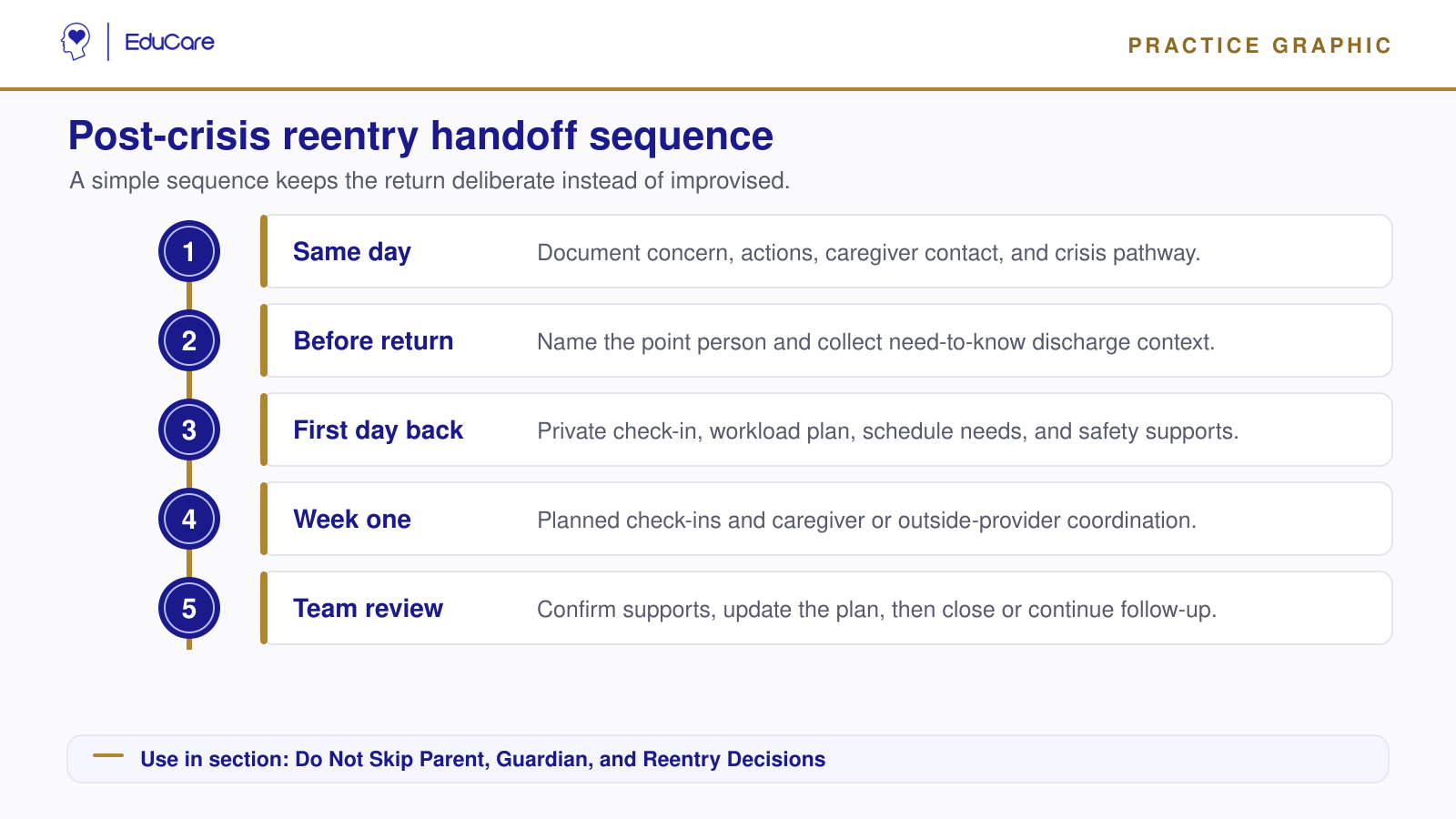
School teams often spend a lot of energy on the initial risk moment and too little on what happens next. The messy points are predictable: caregiver notification, means-safety discussion, transportation, emergency evaluation, school absence, hospitalization, outside therapy, medication changes, and the student's first day back.
A plan that only covers the first disclosure is incomplete.
Parent and guardian communication needs to be specific. Staff should know who makes the call, what must be communicated, how language is documented, what happens if the caregiver minimizes the concern, and how the school responds if the student says caregiver contact will increase danger. Those are not moments to improvise. They require policy, consultation, and clinical judgment.
Reentry also needs structure. A student returning after a suicide-related crisis should not have to retell the full story to five adults. The school should have a designated point person, a plan for make-up work, a private check-in option, a process for sharing only need-to-know information, and a way to monitor whether supports are helping. For some students, the reentry plan may include counseling check-ins, schedule adjustments, reduced workload, informal safety monitoring, threat assessment follow-up, or coordination with outside providers. For others, the plan may be lighter. The point is to make the handoff deliberate.
What Providers Can Do This Month
If you work in a school-based mental or behavioral health role, you do not need to wait for a districtwide rewrite to improve the system. You can start with a narrow audit.
Pull the current suicide risk protocol and ask five questions:
Does it distinguish 988, mobile crisis, emergency medical services, and school-based assessment roles?
Does it tell staff what to do when a student texts 988 from campus?
Does it identify who supervises the student during assessment and caregiver contact?
Does it include reentry after crisis evaluation or hospitalization?
Does it name the documentation owner and follow-up owner?
If the answer is no, write those gaps down. Do not bury them in a committee memo. Turn them into concrete revision items.
Then practice the workflow. Use a brief tabletop scenario with the people who would actually respond: counselor, administrator, school psychologist, nurse, behavior specialist, front office staff, and any district crisis lead. Walk through a student disclosure at 9:15 a.m., a caregiver who cannot be reached, a 988 text conversation, and a next-day reentry. The gaps will show up quickly.
Finally, keep the student-facing language simple. Students should know that 988 is available by call, text, and chat for immediate crisis support. They should also know which trusted adults at school can help during the school day. Do not make the message sound like the school is outsourcing care to a phone number. The better message is: use 988 when you need crisis support, and when you are at school, we also have adults and a plan to help keep you safe.
Closing Thought
988 georouting is a meaningful federal improvement, especially for wireless calls and texts that might otherwise be routed by an outdated area code. But it does not change the school-based provider's basic job. We still have to build the local workflow, document decisions, involve caregivers appropriately, coordinate with crisis partners, and make reentry humane and organized.
For EduCare readers, the next step is not to memorize another hotline fact. It is to tighten the part of the system you can influence. Review your school suicide safety plan, compare it against your actual crisis workflow, and use EduCare's school-based practice resources when you need practical support for documentation, coordination, and implementation.
Sources
1133 Mendocino Way
Redlands, CA 92374
admin@educarecomplete.com
(909) 730-5561
educarecomplete.com
Redlands, CA 92374
admin@educarecomplete.com
(909) 730-5561
educarecomplete.com
Copyright © 2026
Created with